Choosing the right educational environment is the most significant decision for the child’s personal and academic growth. The commomly asked questions by the parents are: What is boarding school, and what is the comparison between this model and the traditional schooling? This guide breaks down all that you need to be aware of the structure, cost, benefits, concerns, and how to know whether it is the right solution or not.
What Is Boarding School?
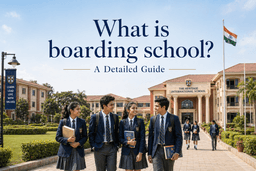
A boarding school is an institution where students stay in a campus duringan academic term. The students stay in the dormitories or hostels unlike the case of day schools where the staffs, teachers and residential mentors attend to them.
Boarding schools provide:
- Academic instruction
- Accommodation
- Meals
- Extracurricular programs
- Structured routines
This setup provides a full-time learning and development environment instead of a classroom-based learning. In simple terms, schooling and living are done in the same environment.
How Boarding Schools Work?
The majority of boarding schools operate on a semester or term basis. During scheduled breaks, the students return home.
Typical daily structure includes:
- Fixed wake-up and sleep schedules
- Academic classes
- Study hours (prep time)
- Sports or activities
- Supervised leisure
The structure promotes discipline, autonomy and time management.
Boarding School Benefits:
Most families consider the benefits of boarding school, other than academic benefits, when making their options.
1. Independence & Self-Reliance
A student is taught to manage the responsibilities, schedules and socialisation without any surveillance by his or her parents.
2. Structured Lifestyle
Daily schedules are beneficial in terms of discipline, productivity, and studying and recreational balance.
3. Holistic Development
Exposure to sports, arts, leadership programs, and community living improves personality development.
4. Focused Academic Environment
Little distraction as in home environments, usually enhance study and concentration.
5. Diverse Peer Interaction
Students communicate with peers from varied backgrounds, and this brings about social maturity.
Day School vs Boarding School:
Understanding the day school vs boarding school differences assists the parents in deciding well.
| Day School | Boarding School |
| Students return home daily | Students live on campus |
| Family-controlled routine | Institution-controlled routine |
| Limited extracurricular time | Extensive activity exposure |
| Strong daily family bonding | Periodic family interaction |
| Lower overall cost | Higher cost (includes stay) |
Neither model is universally better – suitability depends on the temperament of the child, his or her goals and family circumstances.
Boarding School Cost & Fees:
Boarding school cost is one of the most viable ones.
Expenses usually include:
- Tuition fees
- Hostel/accommodation charges
- Meals
- Uniforms
- Activities & facilities
- Security deposits
Speaking of the boarding school fees, it is always necessary to check whether costs are:
- All-inclusive
- Term-based or annual
- Subject to additional charges
Elite institutions often carry premium pricing, but there are low-cost boarding schools which provide quality education.
Affordable Boarding School Fees: What to Expect?
Parents who are looking for affordable boarding school fees should look at this.
Lower-cost options can differ in:
- Infrastructure quality
- Class size
- Facilities
- Location
However, it is possible to offer strong academic programs and disciplined environments at affordable boarding schools. Quality does not necessarily mean cost.
Pros and Cons of Boarding Schools:
The expectations are brought to reality by evaluating the pros and cons of boarding schools
Pros
- Builds independence
- Structured academic focus
- Access to diverse activities
- Strong peer networks
- Reduced digital/home distractions
Cons
- Homesickness (especially early years)
- Limited daily family interaction
- Adjustment challenges
- Higher financial commitment
Success depends heavily on institutional support and emotional readiness.
Is Boarding School Good or Bad?
One of the most parental dilemmas: Is boarding school good or bad?
The right answer: it depends.
There is no universal answer. Boarding school can prove highly helpful to the students who find it easy to adapt themselves to a well-organised environment and the mode of living independently. The children with difficulties in coping with the separation or requiring extra emotional support can find it stressful.
The question should shift from “good or bad” to “good for whom and under what conditions.”
Who Should Consider Boarding Schools?
Boarding education could be appropriate for:
- Students needing structured discipline
- Children seeking independence
- Those pursuing intensive sports/arts training
- Families in remote locations
- Students preparing for competitive environments
Residential schooling does not always succeed with every child, and that is quite normal.
How to Choose the Best Boarding Schools?
When looking for the best boarding schools, parents should evaluate institutions through various perspectives as opposed to using the rankings or adverts.
- Academic Reputation
Look beyond board exam percentages. Look at the depth of the curriculum, the qualification of faculty, the retention of faculty and specialisation in subjects. - Pastoral Care
Residential schooling requires strong emotional support systems. Evaluate the presence of trained counsellors, mentor programs, student grievance mechanisms, and support of adjustment of new boarders. - Safety & Security
Review supervision procedures, campus monitoring systems, building access control, and emergency response procedures. Reliable medical facilities, an alliance with hospitals and properly laid down safety measures are necessary. - Facilities
Evaluate the comfort of dormitories and the level of hygiene, sporting facilities, labs, libraries, and other recreational centres. The facilities are sufficient to ensure complete development and reduce stress in lifestyle. Functionality and maintenance matter rather than the visual appeal. - Culture & Values
Understand the school’s discipline philosophy, inclusion, peer culture, and routine. Institutional culture is the behaviour that determines student confidence, behaviour, and social aspects.
Final Thoughts
Understanding what is a boarding school will help a family go beyond assumptions and test facts. The learning atmosphere provided by boarding schools combines academics and life skills, discipline and self-improvement.
It becomes a life-changing experience for some students.
A day school can be more supportive and efficient for others. The right decision emerges as a result of a truthful evaluation of:
- Child’s personality
- Emotional readiness
- Academic goals
- Budget considerations
- Institutional quality
Board education is not only about the place of study of a child- it is a place where they develop.